Breaking the Code of Silence on Race in Law School

This piece was co-authored by Kyle Alagood, another student at the LSU Law Center. It first appeared in the Huffington Post on October 23, 2014. 

There is an unspoken rule here in Louisiana: Do not talk about race. The rule should surprise few. After all, race is intermingled with the state’s history, institutions, and current policies. We were a slave state. We were a Jim Crow state. Our schools were segregated. Some of our schools are still segregated. Our prisons are disproportionately populated by men of color. The list goes on. To openly discuss race is too complex or too uncomfortable for polite conversation. So society has determined race is off the table.

But to talk about race is to educate. Too often, the norm extends beyond polite conversation and into places where race is relevant — the law school classroom, for example. At the Louisiana State University Law Center, where we both study, the silence on race is deafening. It is deafening because race is never really off the table. Students discuss race with members of their own racial group, but they rarely have interracial conversations on race. As a result, students never learn about other people’s lives or experiences — they never become culturally competent. And when race is off the table, even the best-intentioned faculty risk losing the ability to engage with their students.

Take the following exchange at the LSU Law Center for example: A group of mostly black students was gathered in the Law Center’s lobby when an older, white faculty member walked into the building. Passing by the group on the way to the elevator, the faculty member said, “What is this, a craps game?” Flashing a grin, the faculty member disappeared into the elevator.

Let’s take a step back for a moment. The question was not objectively offensive, at least in the sense of the individual words. The faculty member’s grin denied any overt animosity to the group. When the elevator doors closed, the faculty member probably congratulated himself for successfully engaging with students, a rare feat in law school. He likely chuckled at his cleverness, never knowing he had just insulted all who’d heard. He also probably never realized the students were gathering as part of an event the LSU Law Center’s chapter of the National Black Law Students Association was sponsoring for Black History Month.

Microaggressions work that way: The speaker may not actually intend to harm his victims. To the privileged majority, microaggressions often seem innocuous, but to the minority at the receiving end, microaggressions “resonate with past experience and contribute to an ongoing sense of being fatally out of place,” as Boston College Law School Professor Catharine Wells puts it. For a black student at a once-segregated law school, where only three of the 36 full-time faculty members are non-white, in a state with more black men in prison than in college, a white professor’s glib remark can be distressing, demoralizing, and isolating. It says to students, “You are different. I noticed. You do not belong here.” In effect, microaggressions prevent integration, thus preventing people from learning from and about one another’s perspectives. The faculty member’s remark invaded students’ celebration of heritage and killed the spirit of their gathering.

Casually comparing a gathering of black students to “a craps game,” however, is more than a microaggression. The comparison is old-school racial stereotyping. The stereotypical image of a black man “shooting dice while speaking ungrammatical English,” according to Professor Leland Ware, has a name — “coon.”

The faculty member most definitely would not have called the students a bunch of “coons.” He did not mean his comment to be offensive the way “coon” would be. Nevertheless, it only takes a small amount of historical or cultural understanding to realize the faculty member’s seemingly harmless joke is rife with prejudice, hurt, and hate. The faculty member never apologized for his comment. He probably never realized his statement’s meaning or impact.

That a successful lawyer, litigator, and constitutional scholar at a flagship state law school has such a glaring lack of cultural competency is the result of a law school and legal profession that do not give meaningful valuation to diversity. That must change. Silence is no longer an option.

A growing coalition of students has chosen to break the unspoken rule that has prohibited them from openly discussing race at the LSU Law Center. The coalition, which includes both authors, was moved to action by scenarios like the “craps game” comment and by the school’s recent decision to recruit 17 “master lawyers and judges” — 15 of whom are white — to teach a one-week intersession course called “Apprenticeship Week.”

At the outset, only three of the LSU Law Center’s 36 full-time faculty members are people of color. Of course, decisions to hire full-time faculty have occurred over decades, during which the Law Center’s decision making has progressed from its overtly segregated history. But the Law Center secured Apprenticeship Week faculty on an ad hoc basis, with all the lawyers in the world (quite literally, since LSU has historically hired some esteemed international faculty) from which to select instructors, which makes Apprenticeship Week an ideal microcosm of decision making at the school. That the Law Center’s recruiting practices ultimately led to an overwhelmingly white faculty speaks for itself. The message this sends to students, especially minority students, is that only white men are “master lawyers and judges” fit to teach practical legal skills.

The LSU Law Center is not alone. According to the American Bar Association, onlyone in five full-time law school professors is a racial minority. But even by that standard, the LSU Law Center is behind the curve: One fifth of the full-time faculty would be seven full-time non-white faculty members. LSU has three.

Faculty diversity, like student diversity, provides for meaningful interracial interactions, which helps all better understand different points of view on law and society. Furthermore, a diverse faculty provides much-needed role models for women and racial minorities, who have traditionally been excluded from the legal profession. At schools like the LSU Law Center, where student diversity has outpaced faculty diversity, women and minority students have fewer opportunities to develop meaningful relationships with professors whose life experiences and paths in the legal profession may help guide them through law school. There are around 130 people of color at LSU Law, but they only have three full-time faculty members who are, frankly, like them. As University of California at Davis School of Law Dean Kevin R. Johnson wrote in 2011, faculty diversity extends well beyond providing role models. Among other things, diversity brings fresh perspectives to legal topics, challenges students to think critically, exposes professors and students to innovation, and influences new scholarship.

When the LSU Law Center selected an almost all-white group of practicing lawyers to teach intersession, the school denied students and faculty an educational benefit. It is the moral duty of every law school in the United States to ensure decision-making processes give meaningful valuation to diversity, because the increasingly diverse world will leave behind those lawyers who do not understand people different from themselves.

Reforming law schools and the legal profession begins with students. Law students must, as students at LSU are beginning to do, break the silence that prohibits us from openly discussing race. Only then will we all learn to respect one another.

Andrew Hairston is a proud Howard University graduate and a second-year student at the LSU Law Center. He is a writer, activist and social engineer. He strives daily to fulfill the commission of Vernon Jordan by disturbing the unjust peace.
Posted in Uncategorized | Leave a comment

The Role of the Black Church in the 21st Century

I dedicate this piece to my father, who celebrates 26 years in the ministry this year. 

Over the past twenty-three years, the church has been one of the most influential aspects of my development. My parents were raised in the Baptist faith, and they met at a church in Winston-Salem, NC. They continued this tradition for me and my sister as we progressed through our childhoods. My experiences at sunday school, bible study and vacation bible school constitute a great deal of warm memories from my early years. The church allowed me to strengthen my passion for reading, develop my oratorical skills and form life-long friendships in a nurturing environment.

From a historical perspective, the Black church has played a significant role in the narrative of Black Americans and our empowerment. I completed The Black Bourgeoisie by E. Franklin Frazier a few weeks ago, and this point was emphasized throughout the text. One passage in the book eloquently illustrates this concept:

“Although much of the religious life of the slaves was under the supervision of their masters and even shared with their masters, they were allowed some freedom. Thus the ‘invisible institution’ of the Negro church grew up where the slaves were permitted to conduct their religious services with a Negro preacher. Under such circumstances, there was greater freedom of religious expression on the part of the slaves.”

During the antebellum period of American history, the Black church almost exclusively provided a place where Black men and women could assert autonomy over their lives. In the face of severe dehumanization, the Black church established a place where sociological independence could exist for enslaved Americans. It can be successfully argued that the  church still maintains this role within the Black community in modern times.

I consider myself to be a supporter of the Black church and its purpose within the community. However, I am cognizant of some of the issues within the church that make people reluctant to offer their full support to the institution. Gender equality may be considered one of the largest issues faced by the modern Black church. Even in current times, well-qualified women are denied the opportunity to preach simply because of their gender. Economic discrepancies also make potential parishioners hesitant about joining a church. The leaders of some congregations, who drive luxury cars and own expensive homes, fervently solicit tithes from members who struggle to make ends meet from month to month. Finally, the traditional nature of the church provides an environment that could be deemed as hostile by young adults. The older members of some churches can be notoriously judgmental and scathing in their remarks to young men and women who choose not to dress conservatively during services.

Despite these undesirable characteristics, I believe that the Black church provides benefits that far exceed any critiques that can be articulated against it. As I alluded to earlier, this institution provides a space in which children can come and flourish. Various ministries in the church require children to read and speak. If a child previously struggled with either skill, it can be addressed by reading a passage of scripture during children’s church or reciting a James Weldon Johnson poem during Easter. The result is a sense of self-worth that cannot be taken from him or her.

Although the church is a spiritual center first and foremost, it is also a business. The biblical principle of tithing, which advises a church member to donate 10% of his or her income to the church per year, provides one of the first opportunities to support a Black business that many people may experience. Donating funds to the church creates an avenue to make a good investment and has a direct effect upon the community-building efforts in which the church engages.

In addition to the confidence it instills and the economic lessons it teaches, the church fosters a space where those who are going through adversity can be uplifted. Although monetary donations are primarily used to pay for the costs associated with operating the building, and to compensate the church’s staff members, they can also be used to alleviate financial burdens that the congregants are experiencing. During the time I’ve spent in the church, I’ve seen numerous ways that the church can assist those who are in need. Food pantries, school supply drives and gift cards are just a few examples of how the Black church ensures that its members have the necessary tools to live a good life.

Finally, the church can serve as an epicenter of political activity. This function is paramount for a demographic of the U.S. population that has been and continues to be disenfranchised. A notable example of the Black church’s influence on this front is the historic election of Barack H. Obama as the 44th President of the U.S. in 2008. The church played an integral role in carrying a young Black Senator from the halls of Congress to the Oval Office. In the face of Supreme Court Decisions like Shelby County v. Holder in 2013, the church must renew its commitment to educating the community about the importance of political advocacy and participation. If it utilizes its resources correctly, the Black church can mobilize its members to raise their voices and impact the political climate of the country through active voting.

Like the nation’s historically Black colleges and universities, the Black church is a Black-owned and Black-operated business that is deeply entrenched in the Black American narrative. It is an imperfect organization, but that should not dissuade believers from offering their support to it. In 2014 and beyond, I envision the Black church as a spiritual place that creates opportunities for political activism, economic productivity and social support. I owe a great deal of my success to the Black church, and I hope you will look past its faults and give it a chance.

– Andrew Hairston

Posted in Uncategorized | Leave a comment

The Wisdom of Our Elders

I delivered this message for Acts Community Baptist Church’s commemoration of National Children’s Sunday on June 8, 2014.

Please bow your heads. Lord, thank you for providing us with the opportunity to convene together in the presence of the Holy Spirit. We are grateful for the angels that you have bestowed upon us that we call children. May we always honor, cherish and uplift them as you have commissioned us to do in your Holy Word. Now, as we approach the preaching moment, I humbly ask that you decrease Andrew and increase your presence so that a powerful message can be conveyed today. This I pray in your mighty son’s name. Amen.

Good morning. First, I must give honor to my Lord and Savior Jesus Christ. I am thankful for the mercy, compassion and grace that exceed human understanding. Next, I thank my pastor, mentor, advisor, friend and father, Dr. Daryl Hairston, for allowing me to speak on such a momentous occasion – National Children’s Sunday 2014. Last, and certainly not least, I express my sincerest gratitude to the congregation of the Acts Community Baptist Church. For nearly two years, you all have steadfastly supported my father, mother, sister and me, and I love each of you.

Our scripture for today, which was read so eloquently earlier, comes from the fourteenth chapter of the book of Proverbs. I shall begin reading at verse one from the New International Version. Please stand if you are able.

1)   The wise woman builds her house, but with her own hands the foolish one tears hers down

2)   He whose walk is upright fears the Lord, but he whose ways are devious despises him

3)   A fool’s talk brings a rod to his back, but the lips of the wise protect them

4)   Where there are no oxen, the manger is empty, but from the strength of an ox comes an abundant harvest.

5)   A truthful witness does not deceive, but a false witness pours out lies

6)   The mocker seeks wisdom and finds none, but knowledge comes easily to the discerning

7)   Stay away from a foolish man, for you will not find knowledge on his lips.

8)   The wisdom of the prudent is to give thought to their ways, but the folly of fools is deception.

You may be seated. In honor of today’s special commemoration of children and their significance, today’s message is entitled the Wisdom of Our Elders. As I begin, I feel the need to incorporate a small anecdote into this speech. After reading a book entitled The New Jim Crow: Mass Incarceration in the Age of Colorblindness by Professor Michelle Alexander – which I highly recommend – I decided to write an article about it for my law school’s newspaper. I worked on this project during the few weeks between the end of the fall semester and the beginning of the spring semester. The editorial board selected it for publication in the February 2014 edition of the periodical, and I used social media to post the piece in its printed form. As you can imagine, the text was difficult to read as a picture on Facebook, so I contemplated sending copies of the newspaper via mail.

However, the requests continued to grow, and I can personally attest to the fact that a law student’s financial resources are limited. Suddenly, the idea dawned on me to start a blog where I could publish the article, as well as write posts on other subjects. You may be starting to wonder – what does this story have to do with the message? I will tell you now. For the past two weeks, I’ve been contemplating writing a post about the passing of the renowned international figures Nelson Mandela, Amiri Baraka and Dr. Maya Angelou. The aim of the post was going to be to inform the reader of how important it is for us to preserve and strengthen the legacies of these literary and political giants. I finalized my decision to start working on it last Sunday, and that’s when Dad informed me that I would be delivering the Children’s Day speech this year. The Lord spoke to me and led me to the decision to merge the two ideas. I’m excited to present the finished product.

For nearly two weeks, the world has mourned the death of the esteemed poet Dr. Maya Angelou. Born Marguerite Johnson on April 4, 1928 in St. Louis, MO, this scholar’s career extended over six decades. Some of her titles included dancer, singer, artist, writer, university professor, and actress – just to name several. Dr. Angelou wrote a six-volume autobiography during her life, and, arguably, her most popular installment was I Know Why the Caged Bird Sings. This book details her impoverished childhood and the experiences that she underwent during her childhood stay with her grandmother in rural Arkansas.

From the foundation she received as a child, she went on to accomplish many remarkable achievements. She acted in the famous television series Roots. She directed the film Down in the Delta. She led the New York office of the Southern Christian Leadership Conference. She worked for a renowned English language magazine in Cairo, Egypt.

Temporarily put yourself in the shoes of the young Marguerite Johnson, who was undoubtedly similar to many of the young faces I see in front of me. She played with her siblings, attended church with her family and frequently contemplated her future. Do you think that the young Marguerite Johnson ever imagined that she would eventually become a GRAMMY-award winning artist, advisor to Malcolm X or the second poet in history to present his or her work at a presidential inauguration?[1] As a young girl playing in her grandmother’s home, she certainly couldn’t have guessed that she would be the recipient of 50 honorary doctorates in her lifetime, nor that she would be the author of the last powerful lines of Still I Rise:

Leaving behind nights of terror and fear

I rise

Into a daybreak that’s wondrously clear

I rise

Bringing the gifts that my ancestors gave,

I am the dream and the hope of the slave.

I rise

I rise

I rise.

Dr. Maya Angelou diligently practiced and perfected her various crafts. Her life manifests the first point of today’s message – it is important to study history to fully understand your rich legacy. Just like the woman in verse one of today’s scripture, Dr. Angelou built her house by being an avid reader and a humble learner. She established her presence in art, music and literature by examining the contributions of her ancestors to the various fields that garnered her interest. I look out in the congregation today and see future doctors, lawyers, artists, writers and ministers. All of you will undoubtedly reach heights attained by Dr. Angelou and soar even higher. This feat will be achieved by using your faith in the Lord to tap into the full extent of your wisdom.

The life of another great storyteller warrants reflection as we delve deeper into today’s scripture. Amiri Baraka was born LeRoi Jones on October 7, 1934 in Newark, New Jersey. The year of his birth occurred only several years after the birth of Dr. Angelou, and the United States faced widespread economic deprivation in the form of the Great Depression. He likely faced the same destitution that most American families experienced during this difficult era in history. He attended Howard and Columbia universities before settling in Harlem. It was there that he became an integral part of the Black Arts Movement.

Amiri Baraka fostered the development of other poets and writers who were embroiled in the heart of the Civil Rights Movement. He did this by establishing the Black Arts Repertory Theater School in Harlem. He used his literary work to take a stand against the rampant forces of oppression and discrimination. One of his early works that exemplified this spirit was his Black nationalist collection of poetry, Black Magic. The Black Arts Movement has been described as a dynamic and effective revolution that was characterized by its advocacy of political and artistic freedom.[2] Amiri Baraka courageously voiced his message of Black empowerment during a time when leaders – such as Malcolm X and Martin Luther King – were being killed for expressing such views. He passed in January 2014, nine months shy of his eightieth birthday, and he unashamedly continued his message until his death.

The life of Amiri Baraka brings forth the second point of today’s message – it is critical to persevere through adversity by using one’s creativity. Each person in this room is incredibly unique, and God has bestowed each of us with specific talents. Like Amiri Baraka, we must be unafraid to fully utilize these talents to uplift the kingdom of the Lord and to fight for justice and equality. Let us reflect on his poignant words by examining this excerpt from his famous poem – Ka’Ba:

Our world is full of sound

Our world is more lovely than anyone’s

Tho we suffer, and kill each other

And sometimes fail to walk the air.

We are beautiful people

With African imaginations

full of masks and dances and swelling chants

with African eyes, and noses, and arms

tho we sprawl in gray chains in a place

full of winters, when what we want is sun.

We will face challenges, but they may be subtler than the ones that were presented to our ancestors. They might be  bad grades or discouraging remarks. They could be carefully crafted denials or unexpected failures.

When adversity inevitably enters our lives, we can return to verse three of today’s scripture passage. Our wise words will protect us from the rods with which life will attempt to strike us. We must stand fearlessly resolute in out faith and allow the Lord to provide discernment for the appropriate use of our talents. When we apply the example of Amiri Baraka to our lives, we will be able to generate movements and work that were previously unfathomable. With the use of creativity and faith, our perseverance will easily defeat any adversity that appears in the journey of life.

One more prodigious historical figure deserves recognition and examination today – the Honorable Nelson Mandela. Mandela was born on July 18, 1918 in the Transkei region of South Africa. He was the son of a chief and was considered to be a man of royal lineage. After graduating from the University College of Fort Hare, he moved to Johannesburg. He joined the African National Congress in 1942 and formed the ANC Youth League in 1944. His role in the African National Congress made him the subject of increased government scrutiny.

In 1952, he opened a law practice and was banned from his country for the first time. The next three years marked a period of great difficulty for the resilient Nelson Mandela. He hid from the government using various tactics, but he was ultimately apprehended in 1955. This arrest led to the Treason Trial, and, even though he was not convicted at this trial, the government seized him when he returned to South Africa in 1962. This second detention occurred after Mandela traveled abroad to receive military training in Morocco and Ethiopia, and he returned to South Africa with the intention of leading an armed struggle against the oppressive government.

While Mandela was held in custody, the government raided a compound in Rivonia that housed his ANC colleagues. This raid led to the famous Rivonia trial, in which Mandela and his comrades were put on trial for sabotage. He faced the death penalty during this trial, but it did not dissuade him from delivering his famous ‘Speech from the Dock:’

I have fought against white domination, and I have fought against black domination. I have cherished the ideal of a democratic society in which all persons live together in harmony with equal opportunities. It is an ideal which I hope to live for and to achieve. But if needs be, it is an ideal for which I am prepared to die.[3]

The revolutionary leader was ultimately sentenced to life imprisonment. He spent 27 years in prison, during which he missed pivotal moments in the lives of his family members. His mother and son died during his imprisonment, and he was not allowed to attend their funerals. He spent much of his sentence in isolation as the world’s concern about the apartheid government grew.

The international pressure on South Africa reached a climax in the mid-1980s. Negotiations began for Mandela’s release around the same time, and these efforts culminated in his release on February 11, 1990. He went on to serve as the first President of the new Republic of South Africa. He served one term and lived fourteen more years. I imagine that he used that time to catch up on the countless memories he missed with his family. He passed away in December 2013 at the age of 95. He was surrounded by his loved ones and was revered as an international hero.

The life of Nelson Mandela provides us with the third and final point of today’s message – chase your largest dreams without fear. As the son of a royal chief, Nelson Mandela was fully aware of his potential. He lived his life in the same fearless manner that Dr. Maya Angelou wrote poetry and Amiri Baraka organized Black artists. Because of their courage, these three iconic heroes exemplified the advice of verse six. They discerned the mysteries of life with the tools they discovered along their journeys. Because of their diligent work, they achieved a rich knowledge – one that I am sure the young spirits in front of me are capable of achieving.

With a proper examination of history, a determination to persevere through the challenges of life, and an imagination full of large dreams, there is no limit to the accomplishments that will follow your names. Remember the lessons that you learn during your experiences with the church; they will strengthen your faith and allow you to easily attain the three points set forth in today’s message. Dr. Maya Angelou, Amiri Baraka and Nelson Mandela led remarkable lives, and they influenced millions through their fervent activism. Their exemplary lives show us that it is possible to change the world.

Follow your dreams when they are presented to you. Write the poem. Paint the picture. Stand up against the injustice. Complete these actions whenever the Lord appoints you to do so. You will face difficulties along your journey, but, when they mount up against you, reflect on the words of Proverbs 14:1-8. Equip yourself with the same knowledge that is discussed in this passage by reading and studying constantly.

Recall the journeys of Dr. Maya Angelou, Nelson Mandela, Amiri Baraka and our countless other ancestors when times get difficult. Their resilience carried them through periods when their sojourns seemed impossible, and they reached the ultimate reward of heaven for their exemplary work. Faith, wisdom and courage led to each of them having a significant impact, and I know you all possess these three qualities. Go forward and change the world. Study, persevere and dream. Amen.


[1] http://mayaangelou.wfu.edu/story/family-obituary/

[2] http://www.english.illinois.edu/maps/blackarts/historical.htm

[3] http://www.nelsonmandela.org/content/page/biography

Posted in Uncategorized | Tagged , , | Leave a comment

My Tribute to ASB

In memory of Donald A. Hill, Jr.
1992-2012

The Howard University Alternative Spring Break (ASB) program just completed its twentieth year of service. Born in the Office of the Dean of the Chapel, this university-wide community service initiative has evolved into a multi-pronged effort that reaches six U.S. cities and a foreign country. In the past week, approximately 350 Howard students volunteered over 15,000 hours to address prevalent social issues in various national and international communities. Literacy, gun violence and public health were just a few of the site themes in 2014. ASB played an integral role in my collegiate development. I served as a team leader in New Orleans during my sophomore year and as a general participant in DC my junior year.

Howard and ASB breed leadership. When I reached my senior year, the natural progression in my ASB journey was to apply for a site coordinator position. I loved my experience in New Orleans, so I designated it as my top choice. I was warned that I could ultimately be selected as the leader of a different site, but I paid little attention to this caveat as I submitted my application. About a week and a half later, I received an offer to serve as the site coordinator of New Orleans. The opportunity humbled me, and I felt as though my story with ASB was about to come full-circle. I attended my first steering committee meeting shortly thereafter; my mind began to race with ideas to enhance the phenomenal program that had been developed in New Orleans.

A week later, I received a call from Greta Foster, the ASB executive student director. She told me to report to the Carnegie Building to discuss a new program development. I approached the meeting with a little apprehension. My initial thoughts wandered to the possibility of my replacement. However, my doubt was assuaged fairly quickly. Greta and I had worked together in numerous capacities on campus. I was proud to serve under her leadership and was confident that she would not terminate me so quickly after my appointment. Before I knew it, I was sitting across from her in a conference room. She calmly stated that only law students would be visiting New Orleans in 2013.

Despite this change, a new opportunity had arisen to lead a group of students to Baltimore for the first time. She offered me the position as we both sat there. I immediately accepted, but my affirmative reply masked a strong sense of reluctance. Planning a new site would be an incredible onus, particularly because I had begun to fix my creative efforts on the New Orleans trip. Nevertheless, my commitment to Greta and the program trumped these doubts; it didn’t take long for me to fully invest myself in the creation of ASB Baltimore.

The next six months constituted the most challenging period of my Howard experience. I quickly learned that securing housing, food and work sites for a group of thirty people would be a formidable task. Even though certain aspects of the trip were confirmed in the fall, many components remained uncertain in the weeks immediately preceding ASB’s departure day. The journey forced me to rely on faith more than I ever had. Once I fully adhered to the belief in the evidence of things not seen, everything came together perfectly. The unwavering support of the program’s leadership team supplemented my faith, and each member provided daily encouragement that helped me complete the task.

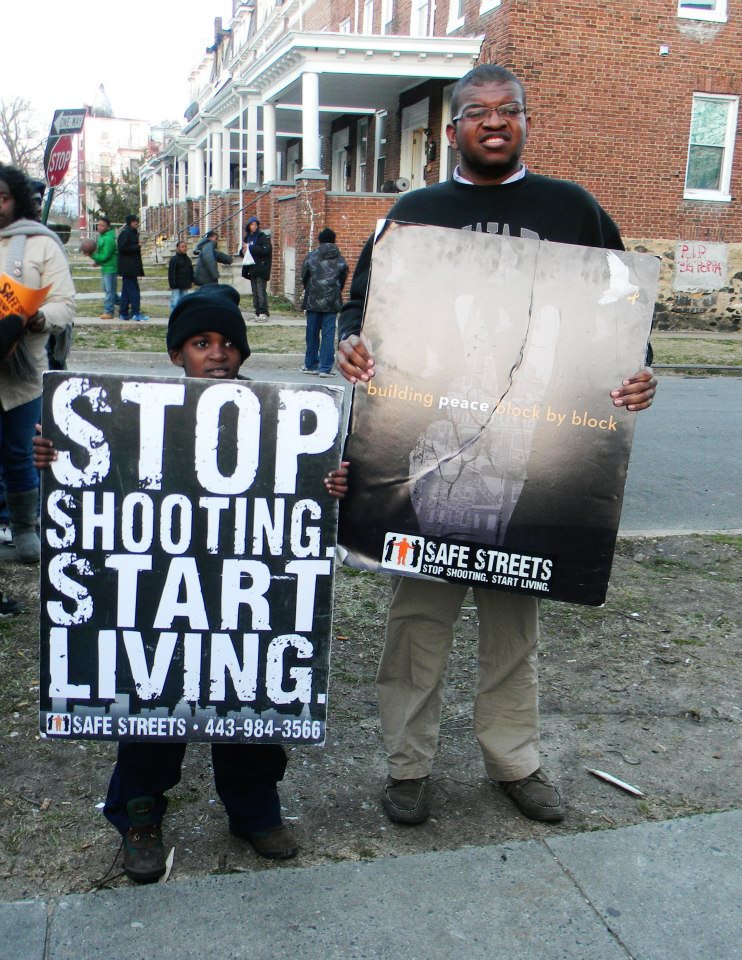
When the week finally arrived, I confidently departed for Baltimore with thirty other Howard students. We worked in an alternative high school to help students pass the Maryland state assessment, petitioned for an anti-gang commission in various neighborhoods and completed a restoration project & anti-bullying seminar at a Baltimore-area Boys and Girls Club. Each experience was incredibly fulfilling, but one stood out in particular. As the program approached the middle of the week, we visited the Mondawmin community in west Baltimore to volunteer with Safe Streets. Modeled after programs such as Cure Violence in Chicago, Safe Streets employs previous offenders to identify young, at-risk community members and mentor them.

One of my favorite pictures from ASB Baltimore 2013

One of my favorite pictures from ASB Baltimore 2013. Taken while canvassing in Mondawmin.

We began our visit by listening to the powerful stories of the outreach workers, and then we embarked upon a community canvassing effort. We walked around the Mondawmin community chanting, “What do we want? Safe Streets! When do we want them? Now!” The outreach workers continued to share stories as we canvassed and pointed out street corners where their community members had succumbed to violence. The goal of the week’s work manifested itself in the two hours we spent in Mondawmin: to positively impact the community by taking direction from residents who were committed to creating a better environment. The months of difficult preparation translated into an invaluable experience, and the Howard participants were able to witness the significant impact of grassroots community engagement. ASB often characterizes its participants as hope bringers. The collaboration with Safe Streets and reaction of the Mondawmin residents confirmed that this classification is well-deserved, but the experience also showed me how much hope the communities give the Howard participants in return.

In retrospect, serving as the first site coordinator of ASB Baltimore was the zenith of my Howard career. It cultivated a strong passion for service and provided me with critical community outreach skills. Over the past week, I tracked the progress of ASB on social media, and the growth of the Baltimore site amazed me. My successor, Joshua Narcisse, strengthened the partnerships that were established last year and implemented new opportunities for the participants to positively impact Baltimore. ASB Baltimore, along with the other sites, will undoubtedly continue to flourish in the years to come. I offer my highest commendation to the program for completing twenty years of service. ASB, thank you for changing my life and the lives of so many others.

– Andrew Hairston

To see some of the great work completed this year, visit the ASB blog.

Posted in Uncategorized | Tagged , , | Leave a comment

The Continued Necessity of Historically Black Colleges and Universities

On March 2, 1867, President Andrew Johnson approved a congressional enactment that chartered the Howard University in the District of Columbia. I dedicate this piece to my alma mater and to the 104 other historically Black colleges and universities in the U.S.

My parents graduated from historically Black universities. My grandmother and great-grandmother attended the Alcorn State University laboratory school and subsequently earned their baccalaureate degrees from the undergraduate college. A host of my aunts, uncles, cousins and friends graced the hallowed halls of schools such as Dillard, Fisk, Grambling, North Carolina A&T and Shaw. I often reflect on my childhood and remember the warm memories I had at Alcorn’s homecomings. I recall being anxious to visit Howard, Clark Atlanta, and Morehouse during my junior year of high school. I was ecstatic when Hampton became the first school to send me a college acceptance letter. From a daily and practical point of view, two HBCU graduates continue to provide food, shelter and clothing for my sister and me.

Admittedly, as the time drew near for me to select a university, I found myself torn between Emory and Howard. The beauty of the former’s campus left an indelible mark on my mind. The resources and prestige certainly didn’t hurt. I announced my intent to attend Howard in March 2009, but the thought of Emory lingered. In mid-April, I made the final decision. I knew that I wanted to continue in the strong tradition that had been paved by my forebears, so I sent the enrollment deposit to Howard. I felt honored to be able to uphold such a legacy.

At this point, I must supplement my personal story with some historical context. Save a few exceptions, such as Cheyney University of Pennsylvania, a good number of historically Black universities were born during the Reconstruction era. The Civil War Amendments abolished chattel slavery, extended the Equal Protection and Due Process Clauses to state governments, and granted the right to vote to those who had previously been enslaved. Members of the African Diaspora were not permitted to read or write during the antebellum period, and the newly bestowed post-Civil War rights created a first-time opportunity for education and social advancement. Historically Black colleges and universities were commissioned to fulfill this new purpose. Nearly 150 years after many historically Black colleges and universities were founded, the pillars of social justice and equality continue to guide their missions.

From a personal vantage point, Howard provided myriad opportunities for me to discern my purpose. I grew academically and spiritually in a community of international scholars. While I was a college student, I journeyed to the Student Non-Violent Coordinating Committee’s Fiftieth Anniversary Conference in Raleigh-Durham, studied abroad in South Africa and led a service trip to Baltimore. I watched my colleagues flourish in student councils, social organizations, community service initiatives and internships. I established life-long friendships with people who are now pursuing careers in business, government, education, law and medicine. My four years passed swiftly, and I turned my tassel with immense gratitude when the day appointed itself.

A rainy day in June 2013 stands out with particular clarity in my memory. My degree had been conferred a little over a month earlier, and I had never been more proud of my HBCU. On my way home from work, I got caught in a torrential downpour and sought shelter under the awning of a building near U Street. I scrolled down my Facebook news feed to pass the time, and an article caught my attention. I followed the link and was dismayed to see that it concerned a leaked letter written by the Vice-Chairwoman of Howard’s Board of Trustees. Citing fiscal mismanagement, the letter asserted that the university would not exist in three years if drastic measures were not taken. In the following months, the bad press continued. A credit downgrading, a staff downsizing and the abrupt resignation of the president are just a few examples of the increasingly negative media portrayal of Howard in the latter months of 2013.

These isolated events do not reflect the campus that nurtured me for four years. When I think of Howard, I imagine First Lady Michelle Obama addressing students and encouraging participation in study abroad programs. I imagine the upper quadrangle, more commonly known as the Yard, filled with an infectious positive spirit on the first day of spring. I imagine the convergence of brilliant minds from nearly all fifty states and numerous countries around the globe. I imagine California Attorney General Kamala Harris delivering an inspiring message at the 145th Charter Day Convocation. I imagine political science students studying Bunche and Foucault, psychology students studying Freud and Fanon, and English students studying Faulkner and Morrison. These imaginative thoughts coincide with my collegiate reality.

While I was an undergraduate student, I would sometimes run into classmates who were frustrated by the administrative processes of the school. Any HBCU graduate will likely be able to share a less-than-favorable story about their alma mater’s financial aid or student accounts office, but that’s the beauty of the HBCU. Through the numerous forms of adversity they face, historically Black colleges and universities continue to persevere and produce exemplary graduates. No institution of higher learning is perfect, but historically Black colleges and universities have accepted and executed the challenge with which they have been tasked.

In recent months, grievances articulated by Black college students have continued to catch my attention. These voices emanate from the campuses of elite universities like UCLA and Michigan. The concerns voiced by these students reaffirm my belief in the necessity of historically Black colleges and universities. The HBCU creates a space in which a student can express his or her individualism while immersed in a supportive and collegial environment.

Historically Black colleges and universities are deeply intertwined in the fabric of the American narrative. They serve as beacons of hope and incubators of intellectual curiosity. They instill confidence and promote leadership. They foster innovative research and produce esteemed professionals. They cultivate a passion for service and a commitment to altruism. If I am blessed to have children, I hope they will choose to embark upon the same effort I have to preserve the formidable legacy of historically Black colleges and universities. Until that time comes, I will continue to advocate for these schools, support them financially and laud their contributions to the national and global communities. I hope you will too.

– Andrew Hairston

Posted in Uncategorized | Tagged | 1 Comment

Call to Action: A Review of the New Jim Crow

This piece appeared in the February 2014 edition of the LSU Law Center’s Student Publication – The Civilian. 

As I began my junior year at Howard University in August of 2011, I was drawn to the story of Troy Davis. Davis had been accused of killing a Georgia police officer nearly 20 years earlier, and, following the adjudication process, he was ultimately sentenced to death. As his imprisonment term dragged on, various trial witnesses began to rescind their earlier testimonies and the Davis case began to receive more scrutiny from the public. In the days immediately preceding his execution, various civil rights advocacy groups employed the use of the hashtag “Too Much Doubt” to raise awareness about the fast-approaching execution of a potentially innocent man. After several stays of execution, the day of reckoning was set on September 21, 2011. When the day arrived, a group of Howard students and DC residents marched to the White House to demonstrate disapproval of Davis’ execution. However, Troy Davis died around 11:00 p.m. that evening. In the wake of his death, my passion for criminal justice reform was born.

In her insightful first book, Professor Michelle Alexander, a faculty member at the Ohio State University’s Moritz College of Law, combines a well-researched historical narrative with substantive suggestions for criminal justice reform. Alexander’s primary thesis centers around the perennial presence of an American racial caste system that has existed in three forms since the birth of the United States: slavery, Jim Crow, and mass incarceration. Alexander argues that the current caste system of mass incarceration has found a great deal of its origin and power in the War on Drugs. The War on Drugs began during the Reagan Administration, and it has provided local law enforcement agencies with substantial federal grants to address the issue of drug usage in communities across the country. Alexander maintains that the aforementioned federal grants bestowed upon law enforcement agencies the ability to arbitrarily determine who they would target in their effort to curb the use of drugs. The result is that myriad Black and Brown people have been relegated to second-class citizenship for non-violent drug offenses.

As stated by Alexander, “Those trapped within the system are not merely disadvantaged, in the sense that they are competing on an unequal playing field or face additional hurdles to political or economic success; rather, the system itself is structured to lock them into a subordinate position.” The current system authorizes legalized discrimination against felons; the people who have been ushered into the system are often denied the right to vote and cannot access public funds for education, among other limitations. Additionally, felons must pay numerous court fees upon their release; even if they are able to overcome insurmountable odds and obtain employment, the government can seize a large percentage of their wages. The effects of this system have resulted in the creation of an undercaste defined largely by racial terms, and this undercaste is constantly denied access to rights that are often taken for granted by other American citizens.

Throughout the book, Alexander asserts that crime rates have not increased in the manner that incarceration rates have over the past three decades. Drug usage occurs at similar rates across communities in America, regardless of the ethnicity of the user. Therefore, Alexander argues that mass incarceration merely represents another form of institutionalized racial control as slavery and Jim Crow did in their respective epochs. In the last chapter of the book, Alexander dedicates a succinct paragraph to preliminary recommendations for reform. She states, “All of the financial incentives granted to law enforcement to arrest poor black and brown people for drug offenses must be revoked. Federal grant money for drug enforcement must end; drug forfeiture laws must be stripped from the books; racial profiling must be eradicated; the concentration of drug busts in poor communities of color must cease; and the transfer of military equipment and aid to local law enforcement agencies waging the drug war must come to a screeching halt.” A policy approach is imperative for these changes to occur, but such an approach must also be accompanied by love and compassion.

Alexander argues that the current “colorblind” society in which we live has been detrimental to African Americans. She states that racial indifference and blindness form the sturdy foundation for all racial caste systems. She further asserts that as a society, we should hope not for a colorblind society, “but instead for a world in which we can see each other fully, learn from each other, and do what we can to respond to each other with love.” Along with substantial policy reform, love and compassion are necessary to end the current racial caste system of mass incarceration. As a society, our morality is at stake with the continuation of a system that imprisons certain racial groups and relegates them to second-class citizenship at disproportionately high rates. Effective reform should not simply eradicate the system; it should also guarantee that mass incarceration will be the last racial caste system that exists in America. A great deal of work lies ahead, and I am committed to discussing and implementing reform.

– Andrew Hairston

Posted in Uncategorized | Tagged , | 2 Comments