Hello all–
I write from McAllen, Texas, where I’m wrapping up a board retreat for Frontera Fund. I’m so thankful to be among comrades who are fighting to expand abortion access & reproductive care for all. I raised a couple thousand dollars for the ’26 Fund-A-Thon of the National Network of Abortion Funds this spring, and I encourage you to donate to your local abortion fund before May 31.
I finished Hammer and Hoe: Alabama Communists During the Great Depression by Robin D.G. Kelley last night, and I’m motivated anew. I hope you’ll enjoy this reflection; I know I’ll be returning to this text quite a bit in the coming decades, and I look forward to witnessing how it will, in different phases of my life, inform my socialist organizing. If you have read it – or plan to read it – feel free to reach out to further discuss it with me.
*****
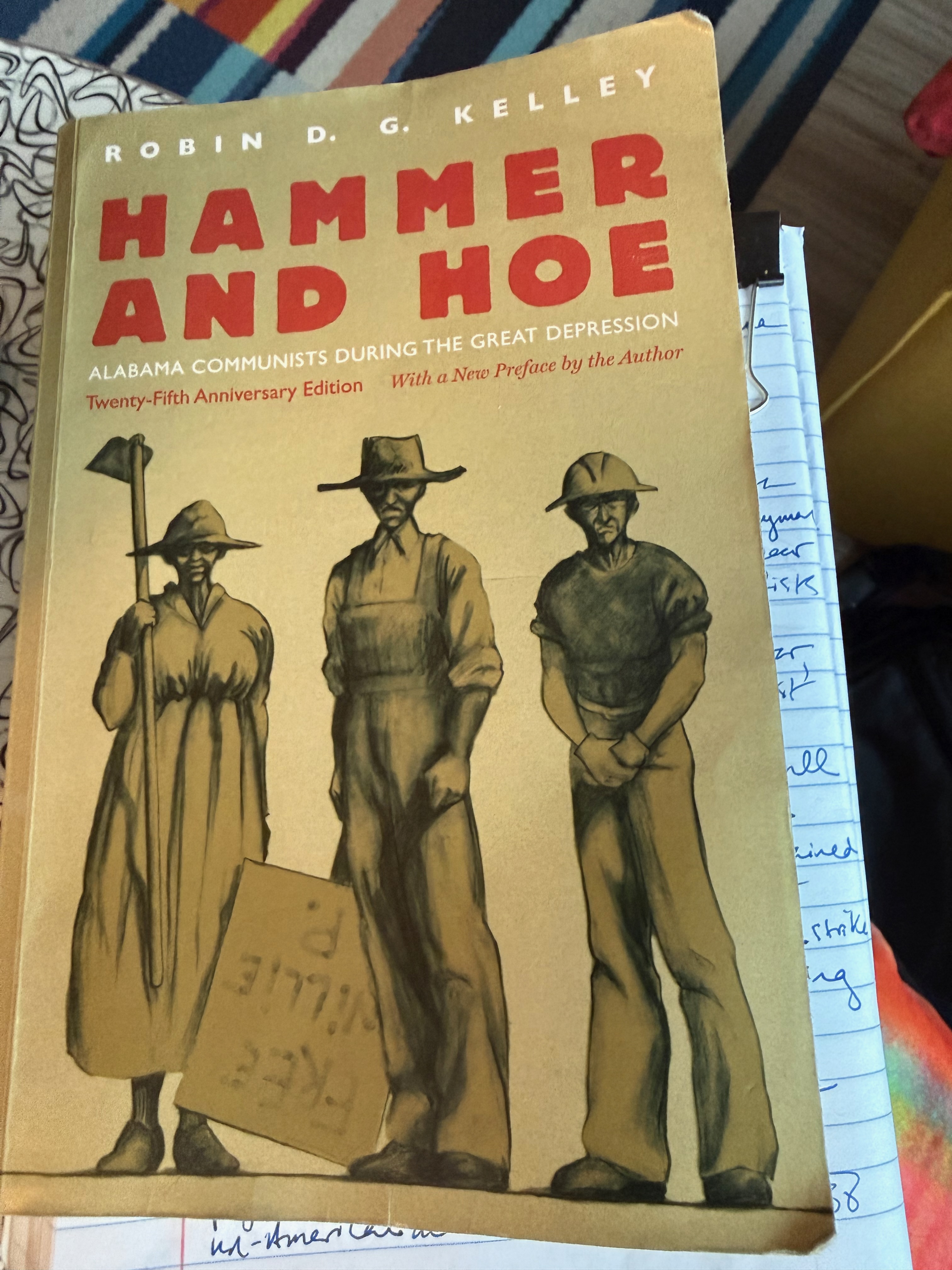
Dr. Robin D.G. Kelley initially published Hammer and Hoe in 1990, as the Soviet Union fell. Despite that irony, the timelessness of the piece emanates from its pages. Dr. Kelley first sets the tone of the class war in Birmingham in the nineteenth and twentieth centuries; a militant, multiracial labor force fought against the greed of the Tennessee Coal, Iron, and Railroad Company – a steel and iron manufacturer – in the years after Reconstruction. Sharecroppers, tenants, and many other working Black people deeply felt the pain of exploitation and racial capitalism, and they sought to direct their indignation into revolutionary action.
The Communist Party planted its seeds as the stock market crashed in 1929; it grew from three organizers in 1929 to over ninety in 1930. At the beginning of that decade, over five hundred people belonged to the party’s mass organizations, and over 80% of these comrades were Black. They labored and organized diligently. Within the next year, on November 7, 1931, the Communist Party held a demonstration in Jefferson County, Alabama that attracted an overwhelmingly Black crowd of five to seven thousand people.
This number truly inspired me. As the Great Depression set in, many comrades were forced deeper into poverty; by 1933, 26,000 Black folks in Birmingham, about 27% of the city’s population, received welfare. Still, comrades gathered, raised their voices against injustices, and brought more people into the fold with each passing month. I smiled as Dr. Kelley illustrated the growing tenacity among the people who were getting radicalized in that moment; in reflecting on the police violence that met thousands of protestors in Ingram Park in Birmingham on May Day 1933, Dr. Kelley conveyed that one Black woman, who had a gun shoved into her body by a police officer, proclaimed that if she was shot, a thousand more would be. At a Communist Party meeting the next day, a group of Black women expressed their excitement – and continued interest – in going toe-to-toe with the racist police force.
As democratic socialists are doing in the twenty-first century, the Communist Party engaged in sustained labor organizing. Sharecroppers formed the Sharecroppers’ Union (SCU) in 1931, and they immediately postured themselves to fight landlords & the government. They executed a cotton-pickers’ strike in 1934 that yielded an increase of wages of seventy-five cents per one hundred pounds of cotton on affected plantations, as well as an increase from thirty-five cents to fifty cents per one hundred pounds of cotton on unaffected nearby plantations. Comrades commemorated this success as they faced kidnappings, beatings, and mass evictions – all while contending with the availability of an expanded pool of cheap labor during the strike. Ultimately, at least 45 strikes, involving over 84,000 workers, occurred in Alabama during 1934.
Dr. Kelley also reflects on the relationship between Black churches and the Communist Party during the Great Depression. Although few Black pastors actively supported the party, some did. Dr. Kelley noted that Reverend George W. Reed of Forty-Fifth Street Baptist Church used his voice as an elder Black clergyman to emphasize the need to be in solidarity with poor folks and build the labor movement. Reading this instantly made me think of my beloved father, Reverend Doctor Daryl Reginald Hairston of ACTS Community Baptist Church in Oklahoma City, who regularly calls out the evils of capitalism in his sermons in 2026. Black Communists who organized ninety years ago recognized the importance of collaborating with the church to reach more people and strengthen their finances during a time of austerity; I personally view my work with fellow democratic socialists in Austin and Baptist churches in Oklahoma & Texas as the two primary pillars of my organizing. Hammer and Hoe reminded me of the importance of going deeper on both fronts in the coming years.
As the Great Depression proceeded, challenges mounted for the Communist Party in Alabama. Increasing anti-Communist sentiment eventually resulted in legislative proposals from the Alabama Legislature that would’ve made labor unions liable for property damage sustained during a strike. The government’s antagonism against the Communist Party arguably culminated in Congressman Martin Dies launching a special committee on un-American activities in 1938. To combat the dwindling numbers of the rank-and-file that accompanied these coordinated attacks, the Communist Party explored more coalitions. Notably, on December 6, 1934, Communists and Socialists from five Southern states released a platform that focused on fascism, particularly lynching, antilabor terror, white supremacist organizations, and sustained opposition to most New Deal policies; they supported Southern unionization, undergirded by racial and gender equality. The Alabama Legislature eventually dealt a final blow to the Communist Party by passing the Communist Control Law, but the willingness of the Communist Party to form coalitions guaranteed that its important ideas persisted in successive decades.
Comrades also faced steady criminalization as the years passed. Using section 4902 of the Birmingham criminal code, which permitted the police to detain people for up to seventy-two hours without a warrant, the police targeted Black comrades like Helen Longs. As she distributed Communist Party leaflets with election information, the police arrested her. They held her for disorderly conduct and beat her to the edge of consciousness. The horrifying story mentally transported me to my current work to dismantle the school-to-prison pipeline in Texas, which includes a recent change to state law, as of 2025, to make it easier to remove students from the classroom for being ‘disruptive.’ The police also used conviction records of comrades to deflate organizing efforts, as they arrested Clayton Norris for a parole violation during a strike against the Works Progress Administration. In response to Black parents of the Ensley Council School who engaged in a boycott to unseat a corrupt principal, the board of education and local police department stepped in and punished the boycotters for truancy; this story made me especially grateful that I further politicized the role of Justice of the Peace in Texas, which handles truancy referrals, during my two campaigns in 2022 and 2026.
Finishing this critically important book certainly left my mind racing. As a socialist who has engaged in electoral work over the past four years, I recognized a connection between my efforts and the community organizing that took place nearly a century ago. I received 9,633 votes in my last run for Justice of the Peace in Precinct One of Travis County, Texas; roughly that number of people belonged to the SCU by the summer of 1935. The Communist Party never achieved an electoral victory in Alabama, but it followed a trajectory from an underground movement in the early 1930s to “a kind of loosely organized think tank whose individual members exercised considerable influence in local labor, liberal, and civil rights organizations” by the 1940s. I am most inspired by the Black Communists of this time period who engaged in multifaceted work, establishing relationships with churches, pushing for political education of union members, and generally building their ranks. Their legacy was beyond apparent thirty years after the Great Depression, when a young Stokely Carmichael encountered enthusiastic and armed Black farmers in 1965 in Lowndes County, Alabama. The radicalism of the Communist Party in Alabama during the Great Depression lives.
I’ll conclude for now with my general appreciation for this tome’s existence. I very likely will return in the coming months with a deeper reflection on the complicated, necessary coalition politics that the Communist Party navigated. A deeper exploration of that work could prove to be quite instructive for the contemporary moment.
As always, solidarity forever.
Discover more from Andrew Reginald Hairston
Subscribe to get the latest posts sent to your email.


